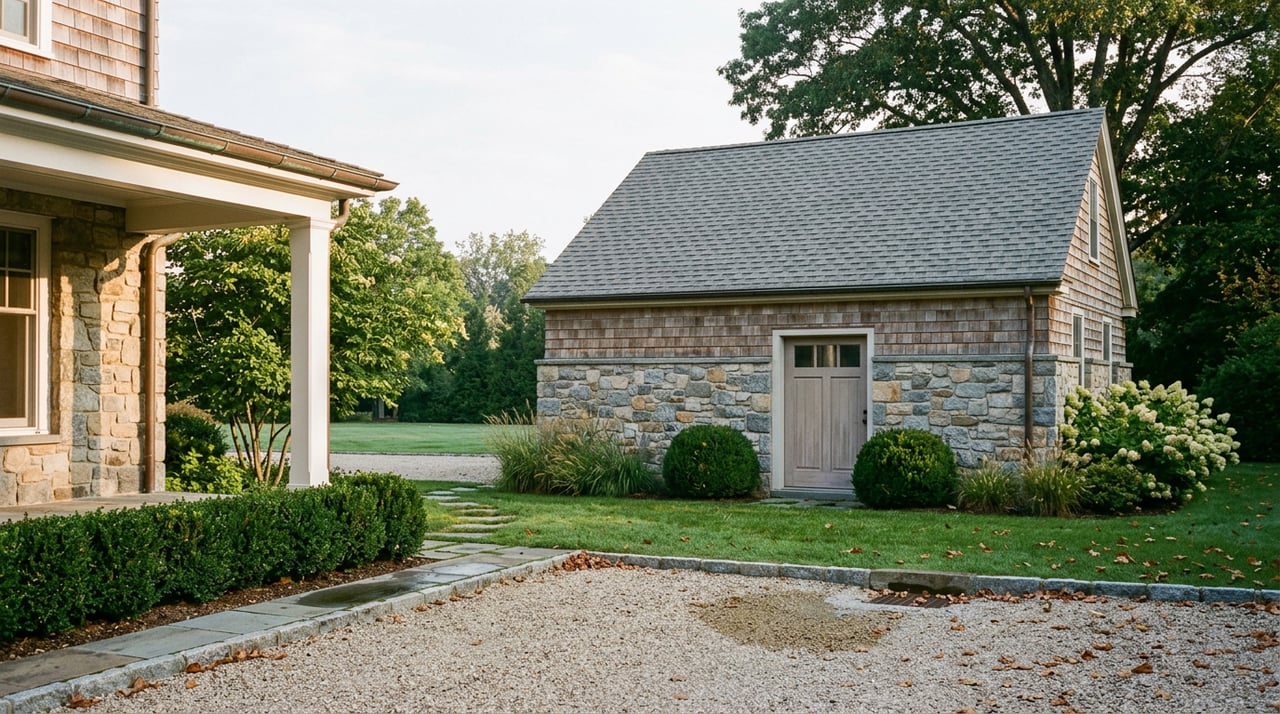
On paper, 108 Henry Street and 35 Ridgeview Avenue could be neighbors. Both carry a Greenwich, 06830 mailing address. Both sit a short drive from Greenwich Avenue. Both landed in front of the town's Zoning Board of Appeals within weeks of each other in June 2025. One sits in an R-6 zone. The other sits in RA-1. That single line on a map decides how large a legal accessory dwelling unit either property could ever hold.
If you're weighing Old Greenwich against Cos Cob against Riverside against central Greenwich for a move that includes a plan for rental income, a suite for aging parents, or space for a caregiver, that zoning line matters more than the village name on the listing sheet. And the rulebook that draws it just got a lot less permanent than the town intended.
The Cap Depends on the Zone, Not the Village
In 2021, Connecticut passed a law requiring every town to permit at least one accessory dwelling unit per single-family lot without a public hearing. Towns had until January 1, 2023 to opt out and write custom rules instead. Greenwich took that option. The Planning and Zoning Commission voted to opt out, and Representative Town Meeting approved the vote in September 2022. The following summer, the town adopted its own accessory dwelling unit ordinance, Section 6-99, effective July 14, 2023.
That ordinance splits ADUs into two tracks, and only one of them treats every property in town the same way.
| Zoning District | External ADU Cap | Internal ADU Cap |
|---|---|---|
| R-6, R-7, R-12 | 800 sq ft | 35% of primary home's gross floor area |
| R-20, RA-1 | 1,000 sq ft | 35% of primary home's gross floor area |
| RA-2, RA-4 | 1,200 sq ft | 35% of primary home's gross floor area |
An internal ADU, built inside the existing house, is capped everywhere at 35 percent of the primary home's floor area. A detached ADU, a separate structure on the same lot, is capped by zone, and the spread runs 400 square feet from smallest to largest. That gap is the difference between a studio over a garage and a real one-bedroom unit someone could actually live in and pay rent for.
The Village Name Tells You Less Than the Zoning Map
Buyers cross-shopping Old Greenwich, Cos Cob, and Riverside tend to picture each one as a single, coherent housing type. None of them are zoned that simply. A 2025 setback variance on Tait Road in Old Greenwich was filed in an R-12 zone. A similar case on Walnut Street in Cos Cob, also R-12, went before the same board that summer. Two villages, two zip codes, the same 800 square foot external cap, and neither buyer would know that from the listing photos.
Back on Henry Street and Ridgeview Avenue, both carrying that same Greenwich address, the caps run 200 square feet apart. The only way to know which bracket a specific parcel falls into is to pull the town's zoning lookup tool for that address, not to assume it from the neighborhood name an agent used in the description.
The village name sells the lifestyle. The zoning map decides what you're allowed to build.
The Owner-Occupancy Rule Nobody Can Confirm
Section 6-99 requires whoever owns the property to live in either the main house or the ADU. That single line matters a great deal to anyone counting on ADU rent while living elsewhere, or to a buyer weighing a two-unit property as an income play rather than a family home.
In 2024, Connecticut passed the Affordable Homes Act. Its Section 7 took effect in February 2025 and appears to remove a town's authority to require owner-occupancy for ADUs at all. Whether Greenwich has formally updated Section 6-99 to reflect that change is not something you can settle by reading the ordinance. Local real estate research covering the town's ADU rules as recently as earlier this year flagged the same open question and recommended calling the Planning and Zoning Department directly to ask whether the requirement is still being enforced.
That is not a small footnote for anyone running numbers on a property with ADU income built into the plan. A rule that reads as mandatory on the town's own page may or may not hold up in practice, and the answer lives in a phone call, not a search result.
Then the State Moved the Deadline to October 1
While Greenwich was refining its own ordinance, the legislature was working on a bigger one. During its 2026 session, which ran from February 4 to May 6, the Connecticut General Assembly passed House Bill 5507, a law that repeals the municipal opt-out provision statewide. Once its accessory dwelling unit provisions take effect on October 1, 2026, every town in Connecticut, Greenwich included, loses the ability to keep the kind of custom opt-out it filed in 2022. The law also bars towns from enforcing owner-occupancy requirements and from imposing design standards stricter than what the state allows.
That date is about a month out from today. The zone-based caps this piece just walked through, the 800, 1,000, and 1,200 square foot brackets Greenwich spent nearly a year writing into Section 6-99 after opting out, do not disappear automatically. But the legal foundation underneath the opt-out itself, the piece that let Greenwich write its own rules in the first place, goes away on October 1. Whether the Planning and Zoning Commission revisits Section 6-99 in response, defends parts of it, or lets state law fill the gaps is a question the town has not answered in public yet.
What This Means If You're Buying With an ADU in Mind
A few things worth doing before you assume a property can support a second unit.
- Pull the parcel's actual zoning designation using the town's zoning lookup tool before relying on the neighborhood name. R-6 and RA-1 can sit blocks apart under the same zip code.
- Call the Planning and Zoning Department and ask directly whether the owner-occupancy requirement is still being enforced. Do not rely on the printed ordinance alone.
- Ask whether the seller has any ADU permit already filed or approved under the pre-October 2026 rules, since new applications filed after that date may be treated differently.
- Remember that as-of-right zoning is not a finished project. Septic capacity, sewer connection, and the Connecticut State Building Code still apply no matter which version of the ADU rule is in force.
Frequently Asked Questions
Does the size cap apply to a converted garage or an existing carriage house? Yes. A garage conversion is treated the same as new construction for square footage purposes, so the zone-based caps still apply.
Will Greenwich's caps get larger after October 1? That isn't settled. House Bill 5507 removes a town's ability to keep its opt-out, but it doesn't specify replacement size limits for towns that already wrote their own ordinance. Greenwich's Planning and Zoning Commission would need to act to clarify how Section 6-99 fits with the new state law.
What happens to an ADU already built under the 2023 rules? A unit permitted and built under Section 6-99 doesn't become illegal because the underlying state law changed. The real question is what happens to applications filed after October 1, not to units already approved.
Buying a home with a second unit in mind starts with a zoning map, not a listing description. If you're comparing properties across Old Greenwich, Cos Cob, Riverside, or central Greenwich and want to know what a specific parcel actually allows before the October 1 change takes hold, request a free market consultation with Spencer Sodokoff and get a straight answer before you write an offer.